From Dawn to Decadence: 500 Years of Western Cultural Life 1500 to the Present by Jacques Barzun
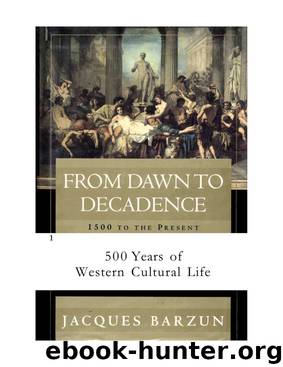
Author:Jacques Barzun [Barzun, Jacques]
Language: eng
Format: epub, mobi
Tags: history; culture; art; literature; religion; manners; science; mathematics, Cultural History
Published: 2011-09-17T03:08:39+00:00
T H E F O R G O T T E N T R O O P < & > 4 5 7
goods by machinery bring on "poverty in the midst of plenty"? The answer was: free competition keeps wages low, free enterprise makes for overproduction, which leads to recurrent "crises"—shutdowns or failures entailing unemployment and starvation.
His detailed criticism of the new society includes the observation that it splits labor from capital and makes them enemies, with the power all on one side. The idea of their "bargaining" over wages is absurd. Tyrant and victim describes the relation, yet without cruel intent of the one or knowledge by the other of who his oppressor is. Again, with overproduction the capitalist must seek foreign markets and precipitate national wars, while at home a class struggle goes on without end: "the poor could say that the employer's life is their death, and therefore his death would be their life."0 But Sismondi does not urge revolutionary massacre. What is needed is protective legislation.
Sismondi does not oppose machinery; he rejects the idea that the economic situation is the inevitable effect of a law of nature, as the orthodox then affirmed. He saw the evils as the result of social and legal arrangements that could be changed. And he instances the guild system, of which one advantage was prudence in procreation. For the modern worker population Sismondi coined the term proletariat, from the class of proletarii (from proles, Latin for offspring) the lowest class in ancient Rome. To give one more sample of Sismondi's perceptiveness: he pointed out that the combination of capital and labor under existing conditions increased the value of each and produced a mieux-valeur [sic]. This is close to the Mehrwert by which Marx demonstrated that labor was exploited (588>). Sismondi's critique of political economy dates from 1818, the year of Marx's birth.
*
* *
Although the Encyclopedists were in no sense democrats, inequality and its evils had been one of their concerns. The revolution ostensibly cured it by the Declaration of the Rights of Man. But did Man include women as it does in other contexts? (<82) One vehement and articulate woman thought not and she undertook to make it so in the simplest way: she wrote a Declaration of Women's Rights, matching the other, point for point, and in full detail.
Olympe de Gouges was illegiti-
mate, married at 16, and left a widow M e n ! ^ y o u capabie of justice? It is a with a large fortune within a few woman who asks the question. At least you weeks. This backing heightened the cannot deprive her of that right. Tell me, who independent temper that caused her has given you the sovereign power to oppress discredit through undignified behavior my sex? Your strength? Your talents?
as well as through affairs. She tried to —OLYMPE DE GOUGES, THE RIGHTS OF
write plays, unsuccessfully, and ended WOMAN {\190) 4 5 8 < S ^ S > F R O M D A W N T O D E C A D E N C E
as a lobbyist for her two causes, women and the monarchy.
Download
From Dawn to Decadence: 500 Years of Western Cultural Life 1500 to the Present by Jacques Barzun.mobi
This site does not store any files on its server. We only index and link to content provided by other sites. Please contact the content providers to delete copyright contents if any and email us, we'll remove relevant links or contents immediately.
| Africa | Americas |
| Arctic & Antarctica | Asia |
| Australia & Oceania | Europe |
| Middle East | Russia |
| United States | World |
| Ancient Civilizations | Military |
| Historical Study & Educational Resources |
Room 212 by Kate Stewart(5120)
The Crown by Robert Lacey(4814)
Endurance: Shackleton's Incredible Voyage by Alfred Lansing(4782)
The Iron Duke by The Iron Duke(4354)
The Rape of Nanking by Iris Chang(4211)
Joan of Arc by Mary Gordon(4110)
Killing England by Bill O'Reilly(4001)
Say Nothing by Patrick Radden Keefe(3985)
I'll Give You the Sun by Jandy Nelson(3447)
Shadow of Night by Deborah Harkness(3368)
Hitler's Monsters by Eric Kurlander(3342)
Mary, Queen of Scots, and the Murder of Lord Darnley by Alison Weir(3210)
Blood and Sand by Alex Von Tunzelmann(3203)
Eleanor & Park by Rainbow Rowell(3173)
Darkest Hour by Anthony McCarten(3133)
Margaret Thatcher: The Autobiography by Thatcher Margaret(3082)
Book of Life by Deborah Harkness(2939)
Red Famine: Stalin's War on Ukraine by Anne Applebaum(2933)
The One Memory of Flora Banks by Emily Barr(2863)
